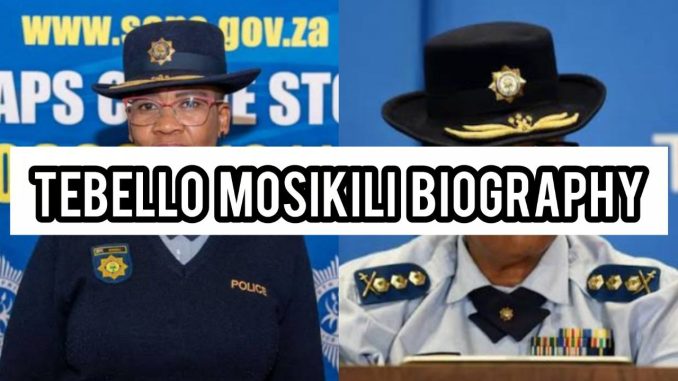
Tebello Mosikili Biography
Lieutenant General Tebello Mosikili was born on July 10, 1974, in the Free State province of South Africa. She grew up during a period of major political and social change in the country. From an early stage, she chose a path of discipline and public service. Her decision to join law enforcement shaped the course of her entire life. Today, she stands as one of the most senior leaders in the South African Police Service, widely recognised as the first woman to serve as Deputy National Commissioner responsible for policing and visible policing operations. Tebello Mosikili is 51 years old as of 2026.
Mosikili joined the South African Police Service in 1989 as a student constable. That decision marked the beginning of a career that now spans more than three decades. Over the years, she has built a strong reputation as a dedicated officer, a skilled investigator, and a disciplined strategist. Her rise through the ranks did not happen overnight. It came through consistent service, leadership in difficult environments, and a deep understanding of both operational policing and national security planning.
Her academic background strengthens her professional experience. She earned a B-Tech degree in Policing from the University of South Africa, commonly known as Unisa. Later, while serving in senior leadership positions, she completed a Bachelor of Laws degree. Achieving a law qualification while leading complex national policing operations reflects her strong commitment to personal development and professional excellence. In addition, she holds multiple professional certificates in areas such as women and the law, project management, and strategic management. These qualifications have enhanced her ability to manage large teams and oversee national crime prevention strategies.
Public information about her personal life remains limited. There are no verified public records detailing her marital status, children, or extended family. Media reports focus mainly on her professional journey and public service record. There is also no publicly confirmed information regarding her ethnicity or religion. These areas remain private and unreported. What is clear, however, is that her background in the Free State shaped her early worldview and influenced her long-standing commitment to public safety and justice.
Tebello Mosikili Career in the South African Police Service
Tebello Mosikili’s career is built on steady growth through almost every layer of policing. After joining as a student constable in 1989, she worked in investigative and detective roles. These early assignments helped her gain firsthand experience in dealing with crime scenes, victims, and community policing matters. Her investigative background later became one of her strongest professional foundations.
She served as Station Commander at several major police stations, including Mangaung, Makoane, Maokeng, Tseki, and Bethlehem. Leading police stations requires strong decision-making skills, operational oversight, and the ability to manage diverse teams. Through these roles, Mosikili demonstrated her capacity to handle complex environments and maintain discipline within her units.
Her leadership expanded when she became Provincial Head of Visible Policing in the Free State. Visible policing plays a critical role in crime prevention. It focuses on patrols, public safety operations, and direct engagement with communities. In this role, she oversaw operational deployments and ensured that police presence was strategically placed to address crime hotspots.
She later served as Deputy Provincial Commissioner responsible for Crime Detection in Gauteng. Gauteng is South Africa’s economic hub and one of its most challenging provinces in terms of crime levels. Managing crime detection in such a region requires advanced coordination, strategic planning, and close supervision of detectives.
Her experience continued to broaden when she led the Family Violence, Child Protection and Sexual Offences unit. This unit handles sensitive cases that demand professionalism and compassion. Her leadership in this area reflected her ability to combine operational strength with empathy and legal understanding.
Mosikili also served as Divisional Commissioner of the Detective Service, where she oversaw national detective operations. In this position, she was responsible for guiding investigative priorities across the country. Her ability to manage large investigative structures contributed significantly to her rise within the national hierarchy.
Before her current role, she served as Deputy National Head of the Directorate for Priority Crime Investigation, commonly known as the Hawks. The Hawks is an elite crime-fighting unit that focuses on serious organised crime and corruption. Leading such a structure requires strategic intelligence coordination and firm operational control.
Her national leadership responsibilities expanded further when she was appointed Deputy National Commissioner for Policing in July 2022 within the South African Police Service. In this capacity, she oversees visible policing, operational policing environments, and Protection and Security Services. She also serves as Co-Chairperson of the National Joint Operational and Intelligence Structure, widely known as NATJOINTS, which coordinates national security planning across multiple government bodies.
Tebello Mosikili Appointment as Deputy National Commissioner
In July 2022, Tebello Mosikili was appointed Deputy National Commissioner responsible for Policing. This marked a historic moment in South African law enforcement, as she became the first woman to serve in this capacity overseeing visible policing operations at national level.
Her appointment placed her at the centre of operational policing strategy. She is responsible for overseeing national police deployment, crime response units, and large-scale security operations. Her portfolio includes protection and security services, which are critical during national events and elections.
Since her appointment, she has frequently addressed the media on issues such as election-related crimes, violent crime prevention, and national security readiness. She plays a key role in coordinating policing strategies during major public events. Her leadership requires balancing operational urgency with accountability and transparency.
In addition to operational duties, she regularly appears before parliamentary structures to provide updates and respond to oversight questions. Her role demands both strategic planning and public accountability. Through her national appointment, Mosikili has become one of the most visible figures in South African policing.
Her position also reflects broader progress for women in leadership within traditionally male-dominated institutions. Rising from student constable in 1989 to Deputy National Commissioner demonstrates a long-term commitment to excellence and resilience.
Tebello Mosikili Controversies and Protest
Despite her strong career record, Tebello Mosikili has also faced moments of public scrutiny. One of the most notable recent developments involved the disbandment of the Political Killings Task Team in late 2024.
On December 31, 2024, a directive was issued by suspended Minister Senzo Mchunu to disband the Political Killings Task Team. Mosikili later testified before Parliament’s SAPS Ad Hoc Committee regarding this decision. She stated that she was surprised and confused by the directive. Just days earlier, on December 28, she had attended a funeral of a SAPS official in KwaZulu-Natal where the minister was present, and no mention of such a decision had been made.
She explained that she only became aware of the directive on January 2, 2025, after returning to Gauteng from festive season policing operations in KwaZulu-Natal and the Eastern Cape. She told Members of Parliament that she questioned the authenticity of the directive because of its tone and the unexpected nature of the instruction.
Given the seriousness of disbanding a national task team, she contacted National Commissioner General Fannie Masemola, who was on leave at the time, to seek clarity and guidance. In her testimony, she stated that the timing of the disbandment raised concerns and appeared premature. She emphasised that task teams remain necessary tools in addressing complex provincial and national crime challenges.
According to her view, task teams are created because certain provinces or business units face specific operational difficulties. Therefore, she questioned why such a structure would be removed so quickly without broader consultation.
In early March 2026, media reports also mentioned allegations of perjury related to a theft complaint she had initiated concerning stolen personal items. Mosikili denied any wrongdoing and maintained that the investigation had procedural issues. She rejected the allegations and affirmed her commitment to legal accountability.
These controversies have placed her in the public spotlight. However, her parliamentary testimony and public responses have been measured and professional. She continues to perform her national duties while addressing oversight processes through formal channels.
Conclusion
Lieutenant General Tebello Mosikili’s journey reflects discipline, resilience, and long-term dedication to public safety. Born in the Free State in 1970, she entered the South African Police Service as a student constable in 1989 and steadily rose through investigative, provincial, and national leadership roles. Her academic achievements, including a B-Tech in Policing and a Bachelor of Laws, complement her decades of operational experience.
Her appointment as Deputy National Commissioner for Policing in 2022 marked a historic milestone for women in South African law enforcement. She now oversees visible policing, operational environments, and national security coordination. While she has faced public scrutiny in relation to the Political Killings Task Team disbandment and other allegations, she has addressed these matters through formal testimony and legal processes.
Tebello Mosikili remains a central figure in South Africa’s crime-fighting and national security structures. Her career continues to shape the direction of policing strategy in the country.
Frequently Asked Questions
What qualifications does Tebello Mosikili hold?
She holds a B-Tech degree in Policing from the University of South Africa and a Bachelor of Laws degree, along with multiple professional certificates.
What was her role in the Political K1llings Task Team issue?
She testified before Parliament stating that she was surprised by the directive to disband the task team and believed the decision was premature.
How long has Tebello Mosikili served in the SAPS?
She joined the South African Police Service in 1989 and has served for over three decades in various leadership roles.

Andrew David writes about finance, agricultural technology, and the newest trends in those areas. He brings nine years of experience and holds both a BSc and an MSc in Economics. His work breaks down complex ideas into clear, practical writing for professionals and everyday readers.
Leave a Reply